Pages

Showing posts with label Northern Flicker. Show all posts

Black and White Warbler


Black and White Warbler
Perched quite upright,
looking prim and proper


Black and White Warbler
And then off up the branch
with a few hops.


Black and White Warbler
Gravity is no problem as it
spirals up and down in any direction.


European Starling
Non-native to the Americas and considered
a pest, the Starling has a striking look.


Gray Catbird
In between complaining about things,
the Catbird pauses for a berry.


Gray Catbird
Then it's ready to start all over
by giving an eye to the perceived threat.


Red Admiral Butterfly
A bright, fluttering splash of
color as it moves from plant to plant.


Chestnut-sided Warbler
One of many migrants, like most
warblers, it seldom sits still.


American Redstart
The mature male of the species is far easier
to identify, even if it moves about very quickly.


American Redstart
The Redstart likes to frequently flare its
tail feathers out as it flitters about.


Rose-breasted Grosbeak
A juvenile on the way to becoming
a fully colored adult.


Cedar Waxwing
Breast feathers ruffled a bit by the breeze,
a Waxwing shows off bright tail feathers.


Dark-eyed Junco
The first ones of the fall are almost always a
surprise because usually it feels way too early.


Dark-eyed Junco
A few at first, then many, and they start their
endless squabbling and flaring of white tail feathers.


Cooper's Hawk
Intent as always on where the next
prey might lurk, waiting to be taken.


Northern Flicker
During the summer they seem more solitary, but
in the fall sometimes half a dozen clump together.


Northern Flicker
One witnesses the magnificent
tail flare of another.


Scarlet Tanager
The female of the species looks very
unlike the brilliant red of the male.

© Michael Bailey All Rights Reserved; Not for reproduction.
No photograph from this blog may be reproduced or used
in any form or by any means whatsover.

Juvenile Birds


Gray Catbird juvenile
Where the upper and lower mandibles of the bill join
is the gape, which is more flexible and brighter in a juvenle.
Just visible here, along with the still-short tail.an>


Gray Catbird
An adult with the darker bill and a
fully formed long tail


Cedar Waxwing juvenile
Almost an adult, but with stripes on
its breast, and still following its parents around.


Cedar Waxwing
A parent perched on the same branch as a juvenile.


Cedar Waxwing
Not as social as normally. two adults
decide to have some kind of dust-up.


Cedar Waxwing
Sitting on a freshly made nest,
incubating eggs at Owen Park.


Chipping Sparrow juvenile
Hopping around on its own in the grass
in search of food. No parents in sight.


House Finch juvenile
Still sporting one or two of the distinctive little
feather tufts on the top of its head.


Song Sparrow juvenile
Finer stripes along the breast and side, with
the distinctive black smear just forming in the center.


Green Heron juvenile
First the long look of this shape-shifter, crest up
and still retaining a few of the head pin feathers.


Green Heron juvenile
Then the short look of the same individual.


Green Heron juvenile
A hop to another metal pole and a medium-length look
as something below has become really interesting.


Green Heron
With an occasional call, it perched high up in a
dead tree at Owen Park, sharing space with a variety of birds.


Osprey
The small golden carp, or goldfish, of Stricker's Pond
make for a good meal for herons and Ospreys alike.


Great Blue Heron
Taking a time-out from the hunt, a Great Blue
Heron climbs through the air up to a favorite dead tree.


Great Blue Heron
Even a tiny retaining pond at Owen Park has the
huge goldfish of the carp family. They're everywhere.


Indigo Bunting female
You wouldn't know this was the
same species as the male.


Indigo Bunting male
The more familiar brilliant color of the male.


American Goldfinch
For late nesters like these, when thistle seeds form,
August is a prime month. It can be both food and nest material.


Baltimore Oriole
Though mating and nesting season have wound down for them,
they still find the energy for a territorial dispute.


Blue Jay
Noisy and highly visible, they elusively appear
and disappear in the blink of an eye.


Northern Flicker
With a wing flared out for a stretch,
all the yellow shafts of the feathers show.


Red-bellied Woodpecker
A male sitting briefly on a branch before
zipping off, trailing chatters, to do the same elsewhere.

© Michael Bailey All Rights Reserved; Not for reproduction.
No photograph from this blog may be reproduced or used
in any form or by any means whatsover.

Great Egret


Great Egret
Lingering briefly during migration, carefully
scratching an itch.


Great Egret
Morning preening requiring a great deal of
neck flexibility.


Great Egret
After all the grooming, time to hunt
for a fish on two in the pond.


Black-crowned Night Heron
A very temporary migrant resting up
in between flights.


Black-crowned Night Heron
Early morning it will come out and preen,
hunt for food, then retire back into the trees.


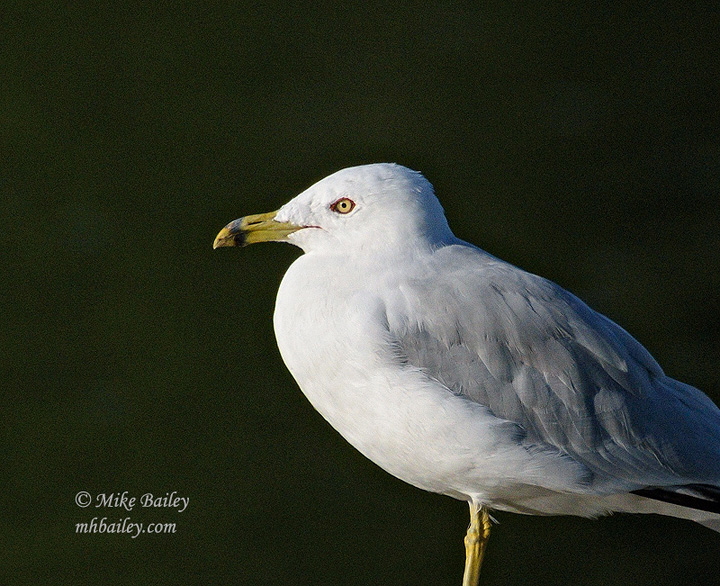
Ring-billed Gull
Always a raucous visitor with its screeching calls.


Osprey
A casual fly over to scan for fish in
Stricker's Pond below.


Osprey
Perched at another time, but it usually gets
one of the large goldfish or carp to eat.


Eastern Kingbird
Alert as always, ready to fight their own
kind and others.


Great Blue Heron
The pre-historic look. The bill has a touch
of blood from an earlier meal.


Great Blue Heron
Wood Duck houses make for great perches
when not actively hunting.


American Robin
Still nesting, though well into August, with a
worm on the way to feed a young one or two.


American Goldfinch
Two chased each other back and forth in a
leisurely manner.


American Goldfinch
It looked a lot more like play than anything else.


Wood Duck
A late season youngster.


Northern Flicker
With a dramatic wing flare the sometimes
hidden, different colors show clearly.


Double-crested Commorant
A juvenile coming in for a landing.


Double-crested Commorant
Showing its Loch Ness Monster, chin up pose.


Rose-breasted Grosbeak
A juvenile with quite a variety of colors.


Cedar Waxwing
An always beautiful and dramatic bird
that for some reason also seems to be gentle.


Sedge Wren
A classic pose with tail cranked up.

© Michael Bailey All Rights Reserved; Not for reproduction.
No photograph from this blog may be reproduced or used
in any form or by any means whatsover.